Save The Dog: Dog vs Bee
- 4.2
- Rating
- 100.00K
- Installs
- Free
- Price
 Analysis by App-foxy
I went into Save The Dog: Dog vs Bee expecting a quick puzzle game built around one clear joke: a puppy is in danger, and I have to keep angry bees away. That simple setup turned out to be the main reason the game works. It does not bury the central idea under a complicated story or a crowded interface. The focus stays on drawing a protective line, reading the situation, and trying to keep the dog safe.
As a free puzzle game from Dongbasiki, it is easy to understand within moments. The store short description calls it “Save The Dog,” while the longer summary points directly to the main challenge: drawing lines, solving puzzles, and protecting the puppy. I found that clarity useful because I always knew what the game wanted from me. It is aimed at Everyone, so the concept is approachable for younger players as well as adults looking for a light distraction.
The game has a playful mood rather than a tense or serious one. The danger is presented as a cartoon problem, not something unpleasant to watch, and that makes it suitable for short sessions around everyday activities. I could imagine opening it while waiting for a bus, taking a break from work, or handing it to someone who wants a puzzle that can be understood without a long tutorial.
You May Also Like

 Blood Strike: 2.5 Anniversary
Blood Strike’s Loadouts Turn Every Drop Into a Tactical Gamble
A close look at Blood Strike’s custom loadouts: how fast access to signature weapons reshapes its battle royale rhythm, rewards preparation, and narrows the gap between fights.

 Pandora - Music & Podcasts
Pandora’s Music Is Easy to Start, but Harder to Recover
Pandora’s strength is its low-effort path from a seed to a station. Its weak spot is how much confidence it asks you to place in connection, setup, and quiet recovery.

 8 Ball Pool
 Is Built on Rivalries, Rematches, and Routine
A close look at the rivalries, rematches, shared routines, and unanswered safety questions that turn a quick pool match into a persistent mobile community.

 Samsung Music
’s Quiet Strength Is Playing What You Already Own
Its reach comes less from spectacle than from dependable access to a personal library. That simplicity is both the app’s strongest retention engine and its ceiling.

 AccuWeather: Weather Radar
AccuWeather Review: A Quick, Clear Forecast for Everyday Decisions
For everyday plans, the best forecast is the one you can understand quickly. AccuWeather makes rain timing, radar, and local conditions easy to act on, with a few trade-offs.

 Hill Climb Racing
Why Hill Climb Racing Still Turns Crashes Into One More Run
A tiny car, a bumpy hill and one more upgrade: Hill Climb Racing keeps resurfacing because its simple chaos makes every near-miss feel personal.
More From Our News Desk
View All News


A cheerful idea that becomes a test of careful drawing
I like how this game turns a cute rescue setup into a small exercise in planning rather than frantic scribbling. In the sections ahead, I’ll look at what makes its drawing puzzles readable, where that simplicity can wear thin, and how to decide whether its focused style fits the way you like to play.
My first impression of the puzzle loop
The first thing I noticed is how quickly the game communicates its objective. The dog is the point of attention, the bees are the immediate threat, and the line is the tool that connects the two sides of the puzzle. That direct presentation gives the opening a friendly, almost toy-like quality. I did not need to learn a large collection of symbols before attempting a solution.
That simplicity should not be confused with a complete lack of thought. Drawing a barrier is easy; drawing one that actually protects the puppy is the real task. A line can look convincing and still leave an opening, fail to cover the important approach, or create a shape that does not behave as expected. The pleasure comes from spotting the difference between a quick scribble and a deliberate solution.
I also like that the game’s premise naturally encourages experimentation. When an attempt fails, the result is easy to understand: the dog was not protected well enough. That makes restarting feel less like punishment and more like another chance to adjust the shape. For players who enjoy trial and error, this is a comfortable design. For anyone who wants every puzzle to have a clearly explained logical route, the experience may feel more dependent on visual judgment.
The game’s current version is 1.0.3, and it requires Android 8.0 or later. Those details matter if you are using an older phone or tablet, but on a compatible device the basic concept is immediately accessible. It has reached over a hundred thousand installs and holds an average rating of 4.2 from a little over a hundred ratings, which suggests that its straightforward appeal has found an audience without making it feel like a huge, complicated production.
The visual language does most of the explaining
The art direction is built around contrast. The dog is the character I want to protect, while the bees provide the visual pressure that tells me where to look and what to anticipate. This is effective because the scene does not need a dense narrative explanation. The arrangement of objects becomes the instruction.
That visual clarity is especially important in a drawing puzzle. If the background were too busy or the characters were difficult to distinguish, the line-drawing mechanic would become frustrating for the wrong reason. Here, the cheerful presentation supports the practical job of reading the board. I can focus on distance, openings, and the likely path of danger instead of searching for hidden controls.
The setting also keeps the mood light. The dog-versus-bee theme gives every challenge a small comic story: the puppy is exposed, the bees are approaching, and I am improvising a shield. Even when my first idea is poor, the tone encourages me to try again rather than treat failure as a major setback.
One useful habit is to stop looking at the dog alone and read the whole scene before drawing. I found that the best first move was often not the most obvious line between the puppy and the bees. A barrier that protects the dog from one direction may leave another route open. Taking a moment to inspect the available space turns the game from frantic doodling into a more controlled puzzle exercise.
Why the setting works better than a generic obstacle course
Many casual puzzle games use abstract blocks, colored pieces, or anonymous targets. This one has a more memorable relationship between its elements. The dog creates an immediate emotional goal, while the bees give the player a moving source of pressure. I am not simply arranging shapes for a score; I am trying to preserve a character that looks vulnerable.
That small narrative layer changes how I approach the board. I naturally draw more carefully because the line feels like a protective object rather than just a solution marker. It also gives the game a recognizable identity. Even without a large story, the setting tells me what kind of experience to expect: playful, quick to read, and centered on clever protection.
The trade-off is that players who prefer deeper worlds may find the setting thin. The dog and bees establish a strong premise, but they are not a replacement for character development or a detailed adventure. I would choose this game for a compact puzzle mood, not for exploration, storytelling, or a broad collection of game systems.
Sound and rhythm matter even in a small puzzle
The game’s mood depends on more than the drawing mechanic. The visual conflict between a cute puppy and angry bees creates a lively rhythm, and the pacing benefits from keeping each challenge focused. I never felt that the premise needed long interruptions. The appeal is in seeing the situation, making a plan, and finding out whether the protection holds.
That rhythm suits mobile play particularly well. A game like this can be picked up for a brief session without demanding that I remember a complicated plot or rebuild a large strategy. It is also easy to pause mentally between attempts. If I become distracted, the central objective remains obvious when I return to the screen.
The sound design, where present during play, should be understood as support rather than the main attraction. The game’s strongest communication comes from the relationship between the dog, the bees, and the drawn barrier. I would not select it primarily as an audio experience. Its atmosphere is carried more by the comic setting and the timing of each attempt than by elaborate musical world-building.
That restraint is a good fit for the concept. A dramatic presentation could make a simple puzzle feel strangely overproduced, while a completely flat presentation might remove the sense of urgency. The dog-and-bee conflict needs just enough movement and reaction to make the result readable. Its best moments come when the visual setup, the player’s line, and the outcome form one quick little scene.
I found that the pacing also affects how much patience I have for difficult attempts. When a puzzle resolves quickly, success feels satisfying because the whole idea is visible at once. When a drawing fails, I want to understand the mistake and immediately test a correction. That is why short feedback cycles are important here: the game’s mood depends on momentum, not on making the player wait through a long sequence before learning whether the plan worked.
How the drawing mechanic fits the theme
The central mechanic is a natural match for the story. A line becomes a wall, shield, or improvised fence, so the action feels connected to the goal. I am not solving an unrelated minigame before returning to the dog. The drawing itself is the act of rescue.
This connection is the game’s strongest design decision. In many puzzle titles, the theme is placed on top of a mechanic that would work just as well with different characters. Here, replacing the dog and bees would remove some of the immediate charm. The danger explains why I am drawing, and the drawing explains how I am helping.
There is also a useful tension between size and precision. A large line may seem safer, but it can be less efficient or harder to place correctly. A small line may use the available space more intelligently, yet leave the puppy exposed. I learned to think of the drawing as a shape with a job, not just as a mark that needs to touch two points.
My practical advice is to plan the endpoints before moving my finger. Look for the direction from which the bees can approach, identify the dog’s most vulnerable side, and then draw a boundary that closes the likely route without making the rest of the scene harder to read. This approach is more reliable than repeatedly tracing around the puppy without considering how the danger moves.
Another useful trade-off is speed versus inspection. Moving quickly feels natural because the bees create urgency, but rushing can cause a line to bend away from the intended protection. On the other hand, overthinking every attempt can make a light game feel like work. I got the best results by taking a short pause, committing to one clear idea, and treating the outcome as information for the next try.
Where it fits among other mobile puzzle games
Compared with match-three games, this title asks for spatial judgment instead of pattern matching. There is no need to search for a chain of identical pieces or manage a board through repeated combinations. Compared with physics puzzles, the appeal is less about manipulating a collection of objects and more about creating a protective solution with one drawing gesture.
It also differs from traditional logic puzzles that present a fixed set of rules and expect a carefully deduced answer. The dog-saving format is more visual and immediate. I can often form a plausible solution quickly, test it, and refine it. That makes it a better choice for casual players who enjoy problem solving but do not want a long written explanation before they begin.
Players who prefer deep strategic systems may be better served by a larger puzzle game with several interacting mechanics. This one is more focused. Its strength is that the dog, bees, line, and outcome all belong to the same compact idea. Its weakness is the same: if that loop does not hold your attention, there is not a separate story or collection system to compensate.
I would also skip it if you are looking for a competitive experience, a rich narrative campaign, or a game designed around long uninterrupted sessions. The Everyone rating and free price make it easy to try, but accessibility does not guarantee that it will suit every taste. It is best for people who enjoy quick visual challenges and a playful rescue theme.
Everyday situations where it makes sense
For me, the most convincing use case is the short break. If I have only a few minutes, I can open the game, solve a handful of situations, and stop without feeling that I abandoned a complicated mission. The dog-and-bee setup is recognizable immediately, so there is little mental preparation involved.
It could also work well as a shared game for a child and an adult. One person can suggest where to draw while the other handles the screen, turning each puzzle into a small conversation about routes, gaps, and protection. Because the premise is easy to explain and the content rating is Everyone, it has a more approachable family feel than puzzle games built around darker themes or complex terminology.
There is a subtle learning benefit too. The game encourages players to consider boundaries, anticipate movement, and notice that a visually large solution is not always the most effective one. I would not describe it as an educational tool, but it can exercise basic spatial reasoning in a way that feels like play rather than a worksheet.
For a commuter or someone waiting in a reception area, the main advantage is low commitment. The main limitation is that repeated attempts can become less satisfying if the player wants constant novelty. I would use it as one small game in a rotation, not necessarily as the only title on my phone.
What to expect before installing
The game is free, which removes the biggest barrier to trying its central idea. It is listed for Everyone and supports Android 8.0 or newer, so the important practical question is whether your device meets that operating-system requirement. The developer is Dongbasiki, and the current release is identified as version 1.0.3.
I would install it when I want a simple puzzle with a clear visual goal, especially if I like cartoon settings and quick retries. I would not install it expecting a large adventure, a detailed story, or a broad management layer. Knowing that distinction in advance makes the experience easier to judge fairly.
The rating of 4.2, based on just over a hundred ratings, gives the game a positive but not overwhelming reception. I read that as a reason to approach it with realistic expectations rather than as a guarantee that every player will enjoy the same loop. The concept is appealing, but the narrow focus means personal taste matters a lot.
One final practical tip is to play with enough screen space to draw accurately. A larger phone or tablet may make the protective shapes easier to inspect than a very small display. If a line seems to fail repeatedly, I would first reconsider the route and the shape before assuming the puzzle is random. The game rewards understanding the scene more than simply drawing faster.
My verdict on the atmosphere and the play
Save The Dog: Dog vs Bee succeeds because its presentation and mechanic point in the same direction. The puppy, the bees, and the protective line create a coherent little world, while the pacing keeps the focus on quick decisions. The art direction gives the puzzles personality, and the setting makes an otherwise basic barrier-drawing action feel like a rescue.
I especially appreciate that the mood stays cheerful without completely removing the need to think. The game is friendly enough for casual and family play, yet the line placement can still demand attention. Its best quality is that it does not pretend to be something larger than it is. It offers a focused puzzle idea, a playful threat, and a reason to try again when the first drawing fails.
I recommend it to anyone who wants a free, easy-to-read mobile puzzle with a memorable dog-versus-bee theme and short-session pacing. I would steer players seeking deep strategy, extensive progression, or a substantial story toward a different kind of puzzle game. For everyone else, this is a pleasant choice when a few minutes of visual problem solving sound better than another complicated phone game.
FAQs for Save The Dog: Dog vs Bee
01What is the main objective of Save The Dog: Dog vs Bee?
The primary goal of Save The Dog: Dog vs Bee is to protect the dog from a swarm of bees by drawing lines or shapes with your finger. The challenge lies in using strategic thinking to successfully shield the dog, making each level increasingly complex and engaging for players.
02Is Save The Dog: Dog vs Bee suitable for children?
Yes, Save The Dog: Dog vs Bee is designed to be family-friendly and suitable for all ages. The game features simple mechanics and colorful graphics, making it an enjoyable experience for younger players. However, parental guidance is recommended to ensure the content aligns with individual family values.
03Does Save The Dog: Dog vs Bee require an internet connection to play?
No, Save The Dog: Dog vs Bee does not require an internet connection for basic gameplay. You can enjoy the game offline, which makes it convenient for playing on the go. However, some features, such as updates or additional content, might require a connection.
04Are there in-app purchases in Save The Dog: Dog vs Bee?
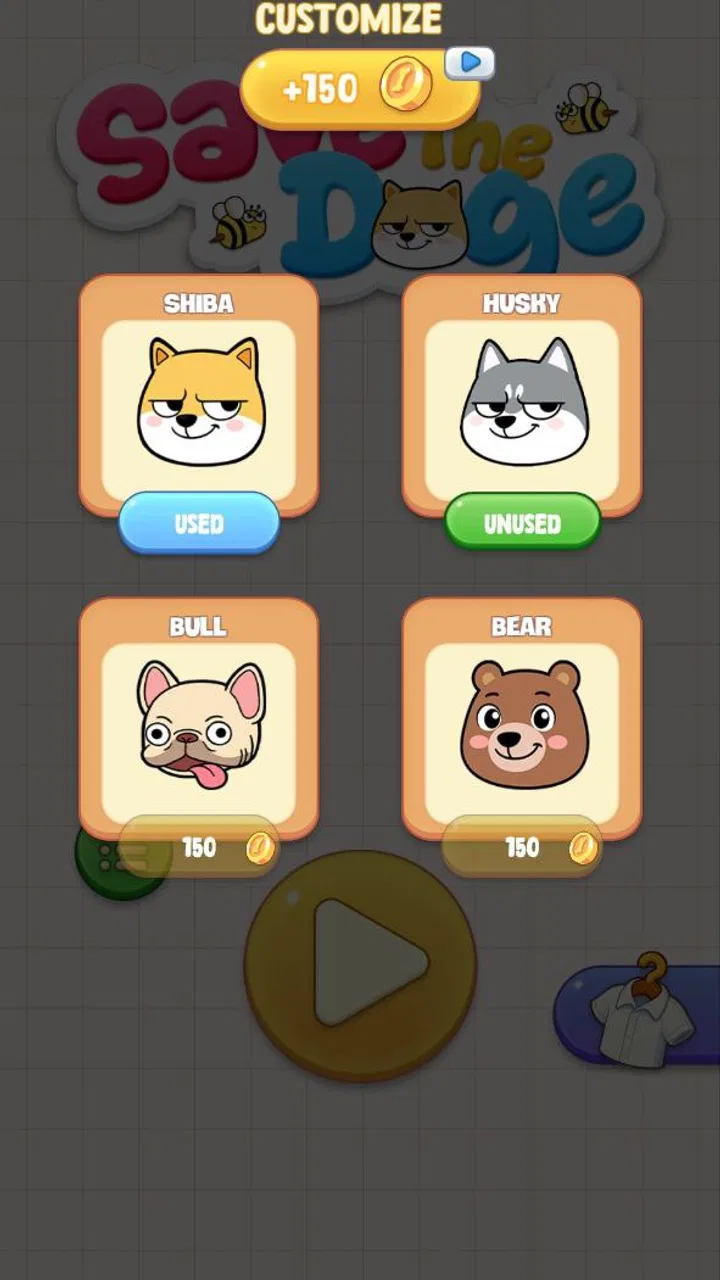
Yes, Save The Dog: Dog vs Bee includes optional in-app purchases. These can enhance the gaming experience by offering additional levels, tools, or cosmetic items. Players can enjoy the game without these purchases, but they provide opportunities for customization and progression.
05What permissions does Save The Dog: Dog vs Bee require upon installation?
Upon installation, Save The Dog: Dog vs Bee may request access to certain device features, such as storage for saving game progress and settings. It’s advisable to review these permissions and ensure they are necessary for your gameplay experience. Always be cautious about granting permissions that seem unrelated to the app’s function.
Pros
- Engaging puzzles stimulate critical thinking.
- Cute graphics appeal to all age groups.
- Frequent updates with new levels and challenges.
- Easy to learn controls enhance accessibility.
- Offline play mode available for uninterrupted fun.
Cons
- Ads can be intrusive and disrupt gameplay.
- Some levels may feel repetitive over time.
- In-app purchases can be expensive.
- Occasional bugs can affect performance.
- Limited social features for sharing progress.

Save The Dog: Dog vs Bee
Gallery